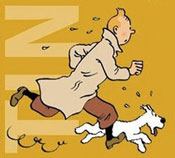
 Perhaps the most famous comic to come out of Europe is The Adventures of Tintin, by the Belgian known as Hergé. It’s known the world over and has appeared in more than 80 languages. Tim and Kumar discuss the comic’s appeal, Hergé’s expert cartooning, and some of the controversies that have swirled around the strip and its creator. Also, Kumar has some observations about the trailer for the upcoming Tintin movie.
- Tintin on Wikipedia
- Examples of story-reinforcing imagery
- Breaking down the layout of a Tintin page
- More Hergé symbolic imagery and page composition
- The Captain Haddock Insult Generator
Podcast: Play in new window | Download
 How often do you hear of two creators at the top of their medium, who set out to create their “magnum opus” and never complete it? Big Numbers is a famously unfinished comics project by Alan Moore and Bill Sienkiewicz from 1990. The theme of the project seemed to be chaos theory, symbolized by the fractal Mandebrot set (shown at right).
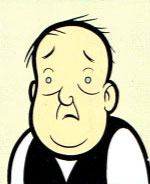
 “Shortcomings” is a relationship story that mixes in issues of race and gender, and features a rather unlikeable character as its protagonist. Some say it’s Adrian Tomine’s masterwork, others say it’s more of the same from him. Tim (battling a cold that’s bestowed on him the voice of a frog) and Kumar (with a mic that keeps going on the fritz) overcome their own shortcomings to discuss the book.
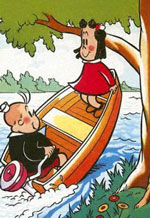 You’ve probably heard of Little Lulu. Perhaps you’ve read one of her comics, or maybe you saw the ’90s cartoon series on HBO. But did you know that, in the mid-20th century, Lulu was a merchandising juggernaut? Tim and Kumar discuss the background of the character, and review the Dark Horse book Lulu Takes a Trip.
 Dave Stevens’ The Rocketeer was part of the early ’80s wave of indy comics that brought us
  The Tokyo Metropolitan Assembly recently passed a law that
  Besides being one of the most highly regarded writers in the comics biz, Alan Moore has also, on several occasions, given artsy poetic readings. Two such readings that he gave in the late ’90s were turned into comics by Eddie Campbell. The text alone is dense enough with meaning, but Campbell’s images add yet another layer. Listen to Moore’s voice recordings of the works as you read and you have a full-on audio-comics experience. Tim and Kumar fawn and praise.
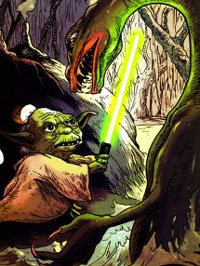 FIVE YEARS of “Deconstructing Comics”! We celebrate with a retro lineup (Tim, Mulele, and Brandon, plus Kumar) discussing the topic that we always used to accidentally end up talking about anyway: Star Wars! Specifically, Dark Horse’s
  From 1985 to 1995, Bill Watterson’s Calvin and Hobbes challenged newspaper readers with imaginative stories, beautiful art, philosophical discussions, and ROTFL gags. Watterson famously eschewed commercialism, not only in the strip, but in real life, approving no C&H tie-in products other than books of strips and a calendar or two. Tim and Kumar discuss this game-changing strip and how relevant it remains today.